Air conditioning has an inconvenient habit: it breaks down exactly when you need it most. That's not bad luck, it's statistics. The unit runs at maximum load on the hottest days, and that's when any weakness accumulated over months finally gives way.
Maintenance isn't a manufacturer's upsell. A dirty unit can consume up to 30% more energy to deliver the same cooling.
What you can do yourself
Every month: the filters
This is the highest-impact task and the most ignored. A clogged filter forces the fan to push air through a barrier, which reduces airflow, cuts performance, and in extreme cases freezes the evaporator.
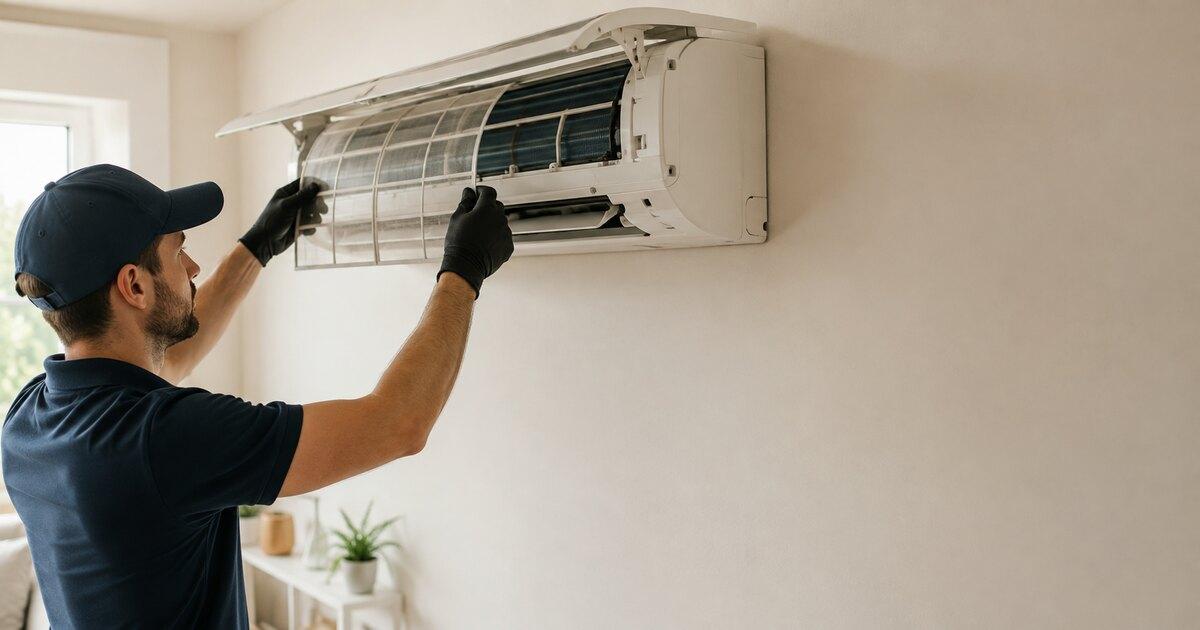
On a split unit, open the front cover, pull out the mesh filters, wash them with warm water and mild soap, and — this matters — let them dry completely before reinstalling. A damp filter is a mold culture.
If you have pets, construction nearby, or someone with allergies, do it every two or three weeks.
Every season: the outdoor unit
The outdoor unit needs to breathe. Keep at least 50 cm clear around it and a meter above. Remove leaves, dust and anything stacked against it. With the power disconnected, you can gently clean the condenser fins with a soft brush, always along the fins, never diagonally — they bend with very little force, and a bent fin blocks airflow.
Every month: the drain
A split unit produces condensate that exits through a hose. If that hose clogs with sludge or algae, the water backs up and ends up dripping inside your house. Check that it drips normally while the unit runs. If nothing drips on a humid day, be suspicious.
Always: keep the airflow clear
Curtains, tall furniture or pictures right in front of the air outlet disrupt the distribution pattern and cause the thermostat to misread room temperature.
What belongs to a technician
Some tasks require instruments, certification and refrigerant handling:
- Measuring pressures and refrigerant charge. A unit low on gas almost never "used it up" — it has a leak. Recharging without finding it means repeating the expense every season.
- Deep chemical cleaning of the evaporator and condenser.
- Electrical checks: capacitors, contactors, compressor draw.
- Verifying the thermostat and temperature sensors.
- Fan bearing lubrication and condition.
A reasonable frequency is one professional service per year for normal residential use, and twice a year in hot climates with heavy use or in commercial equipment.
Signs something is wrong
- It cools less than it used to at the same settings
- The air smells musty or stale, typical of biofilm on the evaporator
- Visible ice on the lines or the coil
- New noises: squealing, rattling, or a loud hum at startup
- Very short cycles, switching on and off every few minutes
- Water dripping inside the room
- An unexplained jump in the electricity bill
One note on smell: if you notice a sweet chemical odor, shut the unit off and call. That can be a refrigerant leak.
Good habits while using it
Setting the thermostat to 16 degrees doesn't cool the room faster; it only makes the compressor run longer without stopping. The unit delivers cooling at a fixed rate. A range of 23 to 25 degrees is usually the sweet spot between comfort and consumption.
Use a ceiling fan alongside the AC — moving air makes the same temperature feel cooler, which lets you raise the thermostat two degrees without noticing.
And if you'll be out for a few hours, raising the temperature is more efficient than switching off and re-cooling the whole house from scratch.
Before you hire
Always ask whether the quote includes chemical cleaning or only basic maintenance, whether it covers a refrigerant check, and whether the technician is certified to handle it. Those are the three points where price and service quality vary most.
Conclusion
AC maintenance is one of those expenses you only appreciate for what it prevents. A fifteen-minute monthly routine plus one annual service keeps a unit running for years.
Post your request on HelpyHub and get proposals from verified air conditioning technicians.