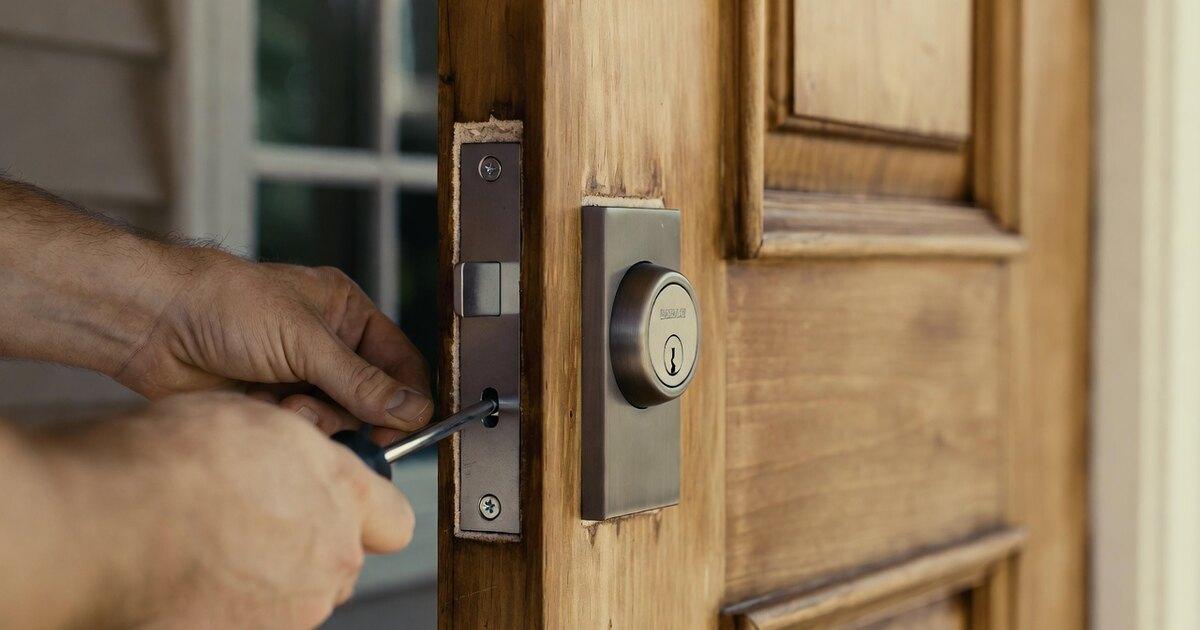
There's a widespread belief that a door's security depends on its lock. In practice, most forced entries don't defeat the mechanism — they defeat the wood of the frame. Someone kicks, the strike plate gives way because it's held by two-centimeter screws, and the lock stays perfectly intact inside an open door.
Understanding that completely changes where it's worth investing.
Lock types and what each is for
Knob or lever lock. The mechanism sits inside the handle. It's convenient, but on its own it isn't a security barrier: the latch is short and beveled. Fine for interior doors; it should never be the only protection on an exterior door.
Deadbolt. A solid bolt that throws into the frame and can't be retracted with side pressure. This is the real security element on most doors. What matters is bolt length: it should penetrate at least 2.5 cm into the frame.
Multipoint lock. A single turn drives several locking points distributed up the height of the door — top, center and bottom. It's what security doors use, and it's markedly more resistant to prying because it distributes the force.
Smart lock. Entry by code, app, fingerprint or proximity. Its advantage isn't so much physical resistance as control: you can grant temporary access, see an access log, and eliminate the problem of copied keys. Choose models that retain a physical emergency key, and check how they behave when the battery dies.
Where the real weak points are
Before changing the lock, check these five things:
1. The strike plate on the frame. This is the metal piece the bolt enters. If it's fastened with short screws, it's barely gripping the decorative trim. Replacing them with 7 to 8 cm screws that reach the structural framing is the cheapest and most effective upgrade there is.
2. The hinges. On outward-opening doors, hinge pins are exposed. Security hinges with fixed pins or set screws solve that.
3. The gap between door and frame. The larger the gap, the easier it is to insert a tool and pry. Excessive clearance is corrected with an anti-pry strip.
4. Glass near the lock. If there's a glass panel within arm's reach of the deadbolt, a double-cylinder deadbolt removes the option of reaching in and opening it. Note: it also complicates exit in an emergency, so weigh it against your situation.
5. The door itself. A hollow-core door offers no resistance no matter what lock you fit. For exterior doors, the reasonable minimum is solid wood or metal.
When to change the lock
Some situations aren't optional:
- When moving in, regardless of how many keys you were handed. You don't know how many copies exist.
- After losing a key or an entire keyring.
- After a separation or change of housemates.
- After construction or a service job where several people had access.
- If the key is hard to turn or has to be wiggled to go in: the mechanism is worn and will fail, probably while locking you out.
- After an attempted break-in, even if it looks like nothing was achieved.
One useful detail: on many locks you don't need to replace the entire assembly — rekeying or swapping the cylinder is enough. It's faster and cheaper, and a locksmith can tell you whether your model allows it.
Beyond the door
A few complementary measures with a good cost-benefit ratio:
- Motion-sensor exterior lighting. It deters more than people assume.
- Window locks, especially on the ground floor and anything facing yards or accessible roofs.
- Sliding doors: a bar or blocker in the lower track stops them being lifted out of the guide.
- A peephole or door camera, so you don't have to open to see who's there.
- Avoid signs of absence: accumulated mail, packages in view, lights off for days.
How to choose a locksmith
This is a trade where trust matters as much as technique, because you're giving someone access to your home. Verify identity and references, ask for a quote before work begins, be wary of very low phone prices that multiply on arrival, and ask for an invoice and a warranty on the installation.
If you're locked out, a professional should be able to open most doors without destroying them. Drilling the cylinder being the only proposed solution isn't always justified.
Conclusion
Reinforcing a door rarely means buying the most expensive lock in the catalog. It means reviewing the whole assembly — frame, hinges, clearances, door — and fixing the weakest link, which usually costs far less than you'd expect.
Post your request on HelpyHub and get proposals from verified locksmiths near you.